The Science Behind the “Magic Milk” Experiment
Science doesn’t always need a lab or expensive equipment. One of the simplest and most interesting experiments students can try at home is the “Magic Milk” experiment. It shows how invisible forces in liquids can create beautiful, colorful movement.
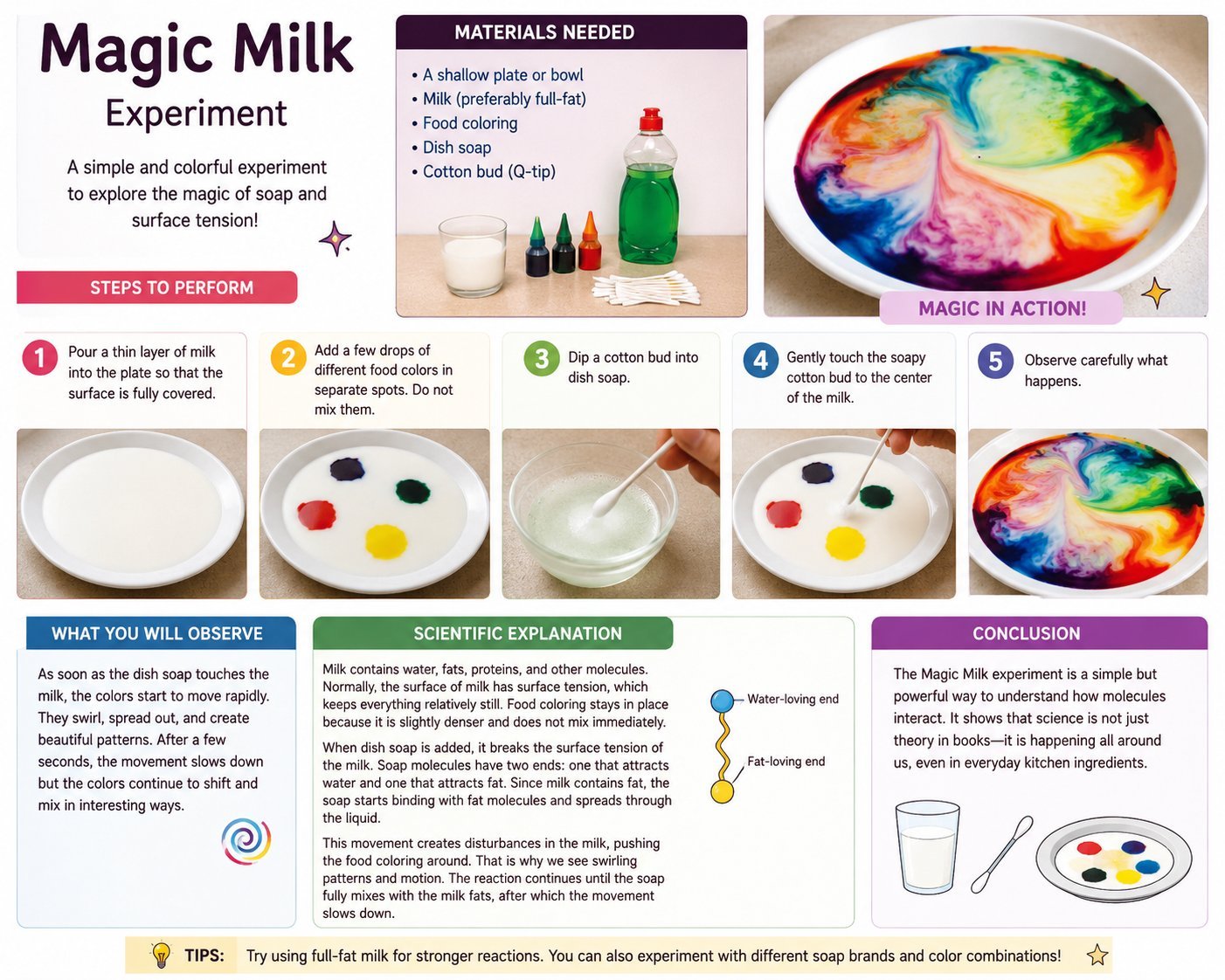
Materials Needed
A shallow plate or bowl
Milk (preferably full-fat)
Food coloring (different colors)
Dish soap
Cotton bud or earbud
Steps to Perform the Experiment
Pour a thin layer of milk into the plate so that the surface is fully covered.
Add a few drops of different food colors in separate spots. Do not mix them.
Dip a cotton bud into dish soap.
Gently touch the soapy cotton bud to the center of the milk.
Observe carefully what happens.
What You Will Observe
As soon as the dish soap touches the milk, the colors start to move rapidly. They swirl, spread out, and create beautiful patterns that look like fireworks or moving galaxies. After a few seconds, the movement slows down but the colors continue to shift and mix in interesting ways.
Scientific Explanation
Milk contains water, fats, proteins, and other molecules. Normally, the surface of milk has something called surface tension, which keeps everything relatively still. Food coloring stays in place because it is slightly denser and does not mix immediately.
When dish soap is added, it breaks the surface tension of the milk. Soap molecules have two ends: one that attracts water and one that attracts fat. Since milk contains fat, the soap starts binding with fat molecules and spreads through the liquid.
This movement creates disturbances in the milk, pushing the food coloring around. That is why we see swirling patterns and motion. The reaction continues until the soap fully mixes with the milk fats, after which the movement slows down.
Conclusion
The Magic Milk experiment is a simple but powerful way to understand how molecules interact. It shows that science is not just theory in books, it is happening all around us, even in everyday kitchen ingredients.