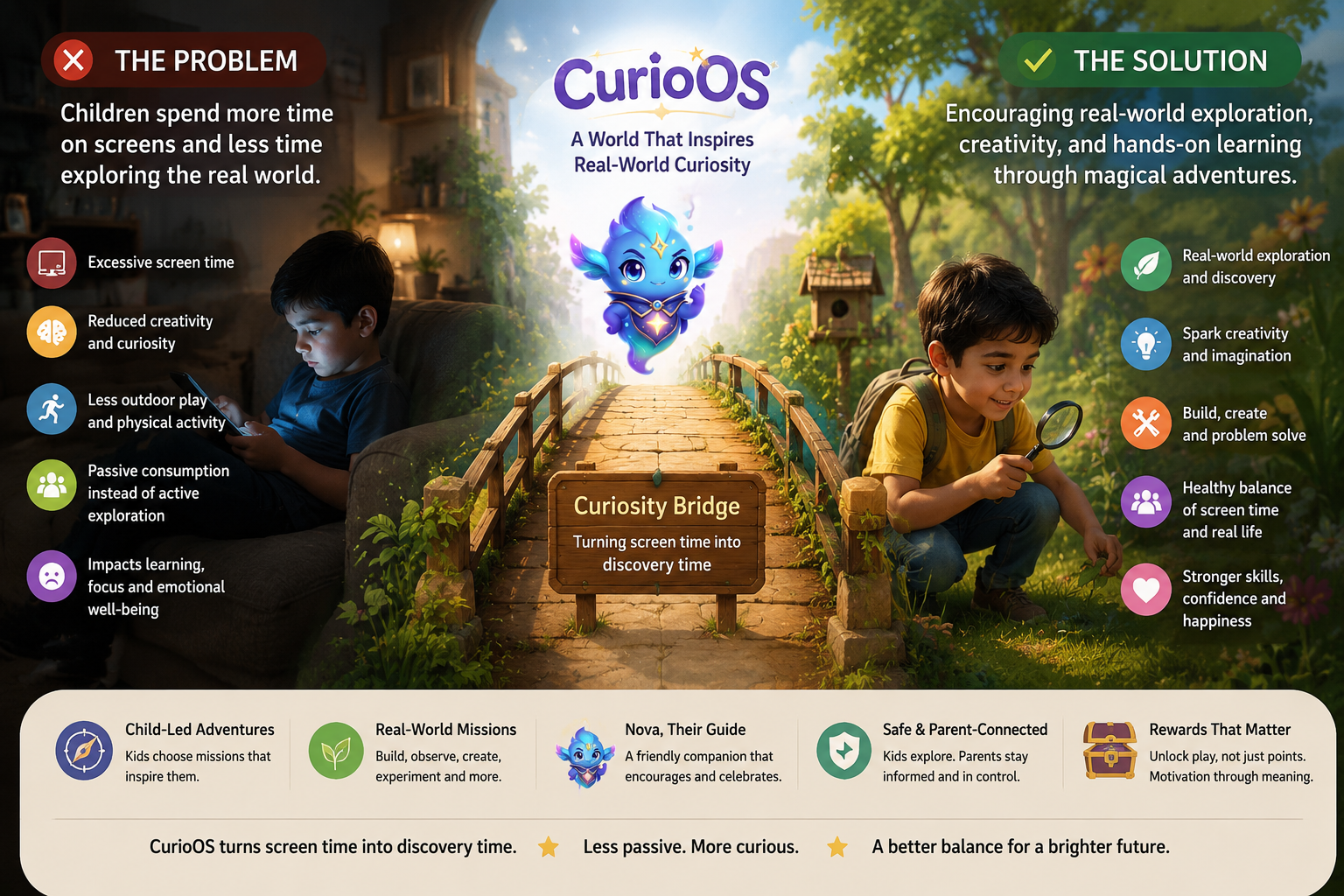
The problem
Millions of children spend several hours every day on smartphones, tablets, and digital entertainment platforms. Most existing parental control solutions focus on limiting or blocking screen time, but they do not encourage meaningful real-world exploration, creativity, curiosity, or hands-on learning. As a result, many children become passive consumers of digital content rather than active creators, explorers, and problem-solvers. Parents often struggle to balance technology use with healthy development, outdoor activities, creative play, and practical learning experiences. Currently, children can access games, videos, and apps instantly, while activities such as building, observing nature, drawing, experimenting, reading, or creating something with their hands often receive less attention and motivation. Existing solutions mainly restrict behavior instead of inspiring positive behavior. This problem affects children, parents, educators, and society by reducing opportunities for curiosity-driven learning, creativity, critical thinking, physical activity, and real-world engagement.
Why it matters
Children develop important life skills through exploration, observation, creativity, experimentation, and interaction with the real world. If children spend most of their free time consuming digital content, they may miss opportunities to build curiosity, confidence, creativity, problem-solving skills, and a stronger connection with their surroundings. Solving this problem would benefit: Children by encouraging active learning and discovery. Parents by providing a healthier relationship between screen time and real-world activities. Educators by supporting curiosity-driven learning outside the classroom. Society by helping raise a generation of more creative, engaged, and independent thinkers.